The project received the Honorary Mention at the CultTech x Ars Electronica Award in 2024.
There is something that touches us all when we let go of our resistance and share a hug. Embracing Places uses immersive technology and body practice to foster connection, solidarity, and appreciation of artistic and cultural heritage.
The project actively involves residents and the unique landscapes of small towns, creating site-specific, community-based artworks that resonate with the emotional significance of each place, establishing an archive of different hugs and a network of towns.
The audience participates in a 360° Virtual Reality experience, where residents of small towns are filmed performing simple gestures like hugging in meaningful local locations. Wearing VR headsets, users are invited to mirror these gestures, transforming their movements into a personal, intimate experience. Spectators without headsets witness the participants’ synchronized movements, creating a live performance that blurs the boundaries between the virtual and physical worlds.
The project emphasizes the importance of preserving local culture and fostering empathy in an age of digital interaction. By highlighting the unique ways different communities express connection, Embracing Places aims to address issues of isolation and bring awareness to the cultural richness of underrepresented towns, creating a living archive of shared, universal gestures.
Landi’s cube (2022-in progress)
Margherita Landi has developed an approach to the body that involves the VR headset to establish direct communication with the performers, who are engaged in the process through the “Landi’s Cube” system. Through Mixed Reality, Landi has constructed a visual language that offers the possibility to direct the performance in real-time, without restricting the creative freedom of the performers. This creates a dialogue that unfolds on stage in real-time, where even the software has a say, generating random elements. It’s a three-way discourse between the choreographer, performers, and the apparatus, characterized by collaboration rather than hierarchy.
The system is inspired by Laban’s cube, the Rubik’s cube, and the game of Twister. It is a playful way to engage directly in a non-verbal form of communication between the choreographer and dancers.
The Landi’s Cube emerges as the future of dance. With its ability to establish direct communication with the dancer’s body, it reduces rehearsal time, enabling boundless collaboration. Potentially, one could travel independently with the headsets, working with local dancers each time, giving rise to a community rather than a company.
However, its potential goes beyond. Over time, the Landi’s Cube could evolve into a tool for notation and storage of performances, preserving the choreographic heritage and facilitating artistic training. From an educational tool to a creative powerhouse, the Landi’s Cube is poised to redefine dance, making it more accessible, collaborative, and innovative. Ready to shape the future of choreography?
Concept, Artistic Direction, Movement Research
Margherita Landi
XR Programmers
Fabrizio Ciolino, Sergi van Ravenswaay, Esther de Bruijn.
Design
Matunda Groenendijk, Charlène Dosso
Production
GOLD
With the support of
VRDays, Eindhoven Design Academy, Cinedans, An Icon (University of Milan)
EMBODYING ABSENCE (2023)
by Margherita Landi and Agnese Lanza
There’s a tendency to perceive absence as immaterial, forgetting that its perception requires access to our physical and emotional memories. In essence, we cannot miss what we don’t know or remember.
“Embodying Absence” represents the final phase of approaching the theme of absence. Following “Dealing with Absence” (absence as distance) and “Touching Absence” (absence as relationship), this last step entails a process of exploring and accepting absence as an inner state.
The project aims to work on real-time learning of a short movement score through a headset, then practicing inhabiting the voids of memory of what has been learned.
The choreographic contents depict scenes evoking something we all know well: children’s play, free and imaginative movement when around the age of 4-5 before being influenced by prejudices or expectations.
For a dancer, the challenging part of accepting memory gaps lies in the judgment that accompanies this moment. In this profession, dancers are expected not to forget any movement in a sequence. The aim is to bring the dancer back to those physical memories preceding the construction of these expectations, to rediscover the beauty of simplicity in any dimension, even in that of emptiness.
The Virtual Reality (VR) headset becomes both present and absent here, serving as the main experiential tool, a mask through which one learns in real-time, teleporting the performer to a childhood place of play and free movement, from which to spontaneously borrow gestures and sequences, constructing a different movement score for each person, albeit starting from the same video material.
The process consists of an “inside” invisible to the audience but perceptible through the dancer’s movements, and an “outside,” which is the resulting performative outcome.
INSIDE (360 video): Through workshops for children, immersive videos were developed where the user is surrounded by children moving and dancing in their own way.
OUTSIDE: A process of accumulation of bodies on stage will be developed. Through a single VR headset, one by one, the dancers learn the choreography. Then, they remove the headset and each one retraces their score until, one by one, following their own inner path and timing, they freeze.
Inhabiting the void of memory produces a mobile and attentive stasis that isn’t static but leads to an incessant inner movement, a rummaging through memories and sensations to retrieve lost gestures.
The phase of memory void will be extended for as long as possible, becoming the predominant phase of the project, an external stasis, resulting from an inner dance, a continuous retracing of the preceding and subsequent moments. A past and a future disconnected from that void, then surrendering to the presence of that single empty moment, which will no longer be “between” two moments but will be “the moment,” the present.
A second phase of the performance unfolds through intimate projections. Using mini projectors attached to their bodies, the artists will place some of the images from which the dancers have extracted choreographic material onto the dancers’ skin, as if bringing forth the visual and emotional memory that generated the show, which in this phase becomes an installation.
At the end of the installation/performance process, the audience will be able to view the choreographic materials through the VR headset, locating corners equipped.
Concept and Choreography
Margherita Landi e Agnese Lanza
Artistic Director, Video e Virtual Reality artist, Creative Technologist
Margherita Landi
Stage, light e sound design
Massimo Bevilacqua
VR Production
Gold
Performance Production
Fabbrica Europa, Compagnia SimonaBucci/Degli Istanti, Parc- Performance Art Research Center
PEACEFUL PLACES (2022)
There is something that touches all of us when we are able to let go of our resistance and share a hug. The world pandemic had destroyed our confidence in this simple action. Peaceful Places are the spaces between our arms. Can we learn to hug again?
Being in an embrace brings us to confront our vulnerabilities, sometimes with the inconvenience of proximity or with the warmth of a touch, but it can also open up a temporal space in which we can allow ourselves the luxury of slowing down and finally listening to ourselves.
Most VR experiences allow the user to interact with a virtual world, Peaceful Places wants to let the users interact with their own internal world, to confront their personal emotions raised from an affective touch.
Real people (not actors or avatars), with real emotional bonds, guide the user’s movement sharing their tenderness, becoming archetypical characters with which we all can identify ourselves.
Auggie Award 2021 winner for Best Art, the project is a participatory and inclusive installation. An experience of proximity, thanks to real couples and their bodies, and at the same time an experience of absence, of loneliness, because the touch and the interaction are only imagined. An imagined action anyway is no less real to our mind. The movement that loses its practical function becomes symbolic, and abstract becomes a dance.
In contrast with the image of bodies as weapons, an image that has been used by various thinkers to define the relationship with the other during the world pandemic, Margherita Landi and Agnese Lanza propose the image of bodies as peaceful places. A way to heal a profound trauma we all lived, especially us Italians who are very physical in the way we express our affection and we had a very long and severe lockdown. After having avoided so many bodies, after being so distant in the last years, finally the opportunity to share a moment of closeness with others. A soft tender dance for changing the world.
a project by Margherita Landi e Agnese Lanza
Choreography and concept
Margherita Landi e Agnese Lanza
VR director and VR concept
Margherita Landi
Post Production
Sasan Bahadorinejad e Cosimo Lombardelli
Cast video 360
Mirko Cuttini, Sara Della Mora, Margherita Landi Agnese Lanza, Iris Pellizzari, Armando Puicher Daria Rizzardi, Giada Rossi, Anna Toscano, Enea Zancanaro
Year of production 2021
Producer
Gold Enterprise
With the support of
Dialoghi/Residenze delle arti Performative a Villa Manin, Festival Contaminazioni Digitali, PimOff
AUGGIE AWARD 2021 for Best Art, Official selection Shorts International Film Festival Trieste, Semi-finalist Dumbo Film Festival NY.
how the installation works.
Real Hugs and Virtual Hugs in Firenze: “Peaceful Places” and “I disarm in your arms”
SWAN – VR moving bodies (2021)
SWAN – VR Moving Bodies is a journey dedicated to 5 spectators at a time, guided through an experiential discovery of a virtual space blending irony, fragility, and grace. It’s a poetic act of irreverent and liberating transformation.
The project is inspired by “The Dying Swan,” the famous choreography by Michael Fokine and performed by Anna Pavlova in 1905-07, set to music by Saint-Saëns.
In her interpretation, Anna Pavlova infused movements into the choreography that expressed her feelings, performing a revolutionary act for dance at that time.
How can we keep alive the revolutionary act that was Pavlova’s Swan?
How does your body experience an intimate action immersed in Virtual Reality?
How do you choose to perform an action? A movement?
How can we transform ourselves into swans?
What constitutes a revolutionary movement?
SWAN – VR Moving Bodies is an intimate and light experience that uses virtual reality as a tool, not an end in itself.
It emerges from the intersection of the poetic research characterizing the two choreographers:
Silvia Gribaudi, a performer and dance maker who has been exploring dance, comedy, and audience interaction since 2008.
Margherita Landi, a choreographer, dancer, and anthropologist who has been researching body and new technologies since 2014.
A project by Silvia Gribaudi and Margherita Landi
VR video curated by Margherita Landi
Performer: Silvia Gribaudi
Production GOLD, Bolzano Danza / Fondazione Haydn e Zebra Associazione Culturale. L’’esperienza è stata creata grazie a “SWANS NEVER DIE “ progetto Biennale ideato da Lavanderia a Vapore/Piemonte dal Vivo, Operaestate Festival Veneto e Centro per la Scena Contemporana CSC,Bassano del Grappa, Triennale Milano, Teatro Brescia, Torinodanza Festival Bolzano danza; “Memory in Motion. Re- Membering Dance History (Mnemedance)” – Università Ca’Foscari Venezia; Ecole Universitaire de Recherche CREATES e Centre Transdisciplinaired’Epistémologie de la Littérature et des Arts Vivants, Université Côte d’Azur.
photo credit: Andrea Macchia
TU-TORIAL #2 From screen to body (2019)
by Margherita Landi and Agnese Lanza
Tu-torial is a project that aims to investigate the relationship between body and technology in choreographic and physical terms.
Observing the bodies in front of screens, projections and VR viewers, a fascination emerges for the contrast between the alienation from the surrounding reality and the involvement created by the content enjoyed, an image that surrounds us every time someone picks up their smartphone, looks at the television or playing a video game.
The research aims to deepen the learning of a physical language from the screen, an action that we unconsciously do every day, and therefore the possibility of creating a choreographic score starting from a video montage.
The reflection stems from the concept of attention, involvement, precariousness and decontextualization of the movement that led to the construction of gestural scores to be learned on the spot by imitating film scenes, in an attempt to bring the content enjoyed into the body.
Through the selection of scenes taken from films by director Jim Jarmusch, movements were extrapolated that, de-contextualized from the narrative, could, on the basis of pure physicality, transform into dance. This second phase of the project is a choreographic exploration of the tools that influence the body, in a path that goes from screen to mobile to VR viewer, involving the audience and bringing it on stage with the dancers through VR technology.
Dance: Agnese Lanza and MariaVittoria Feltre
VR concept and editing: Margherita Landi
Project realized with the support of Company Blu, Kinkaleri and Gold Presented at the Teatro della Limonaia (Sesto Fiorentino) on November 23, 2019 More Works
ATRIO – Theoretical practice (2019)
Atrio is a platform created to foster the emergence of an exchange and horizontal reflection context among diverse artists and audiences over time. It provides an opportunity for sharing based on the interplay between practices and theories, channeled within the realm of contemporary arts, understood in their broadest pluralistic sense.
Through the collaborative research of artists Salvo Lombardo, Margherita Landi, and Fabritia D’Intino, a shared and collective reflection takes shape on the theme of intersectionality and its relationship to the definition and positioning of identities.
Using an inclusive and participatory system for gathering and exchanging information, the experience will blend lectures, performances, and assemblies in a horizontal manner.
The presented framework will engage the audience in a playful, fluid, and adaptable approach, unveiling aspects of identity through the analysis of theoretical, narrative, and autobiographical elements.
Concept and develpment: Fabritia D’Intino, Margherita Landi, Salvo Lombardo
with the support of Associazione Culturale Chiasma
in collaboration of Resurface – Festival di sguardi postcoloniali e Festival Teatri di Vetro \ Trasmissioni
DRIVE YOUR STYLE (2019)
Drive Your Style is a VR short film realized in collaboration with Audi Florence and premiered at Bright Festival 2019. The German giant chose the event to present as national premier E-Tron, the first full-electrical Audi model. E-Tron was exhibited at the Festival, yet, only through the VR experience you could get into the car and visit it internally. In the ad, a dancer performs in a play of transformations leading the audience to explore the space, something possible only by the actual 360° video.
GENRE: short film musical, danza in virtual reality YEAR: 2019 PRODUCED BY: Omar Rashid DIRECTED BY: Omar Rashid PRODUCTION COMPANY: Gold Productions EXECUTIVE PRODUCER: Alessandro Mancini ASSOCIATE PRODUCER: Luca Fortino WRITTEN BY: Omar Rashid, Margherita Landi CAST: Margherita Landi PHOTOGRAPHY: Sasan Bahadorinejad EDITING: Sasan Bahadorinejad POST PRODUCTION: Sasan Bahadorinejad MUSIC: Ian Post
P2P – from People to Profile (2015)
“New forms of loss in the digital era”
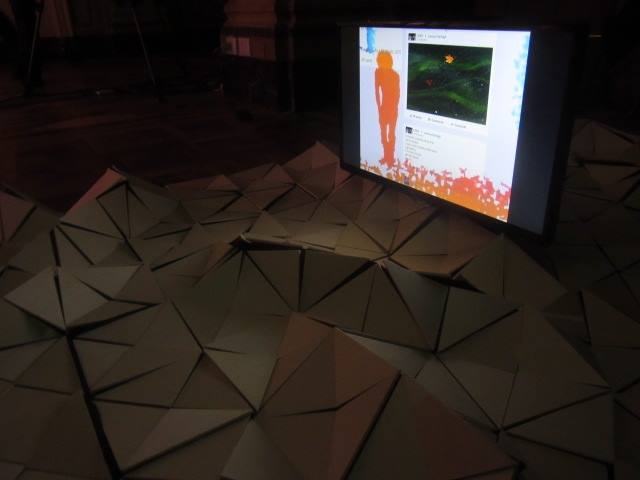
P2P – from People to Profiles is a digital performance developed by the Kokoro collective
The project originates from a reflection on the absence of the physical body in social relations. The chosen borderline case is represented by the exploration of those profiles that remain active after the user’s disappearance and by the relationship that develops in relation to these digital identities, kept alive by those who remain.
The idea came from the group’s communal need to comprehend this new form of absence, to comprehend dynamics such as placing flowers-comments on the headstone-profiles of loved ones who have passed away, searching for their presence in posts and photographs, seeking that last “share” which marks the boundary between before and after.
The performance’s main characters, freely inspired by Facebook profiles of missing persons, are outlined by the words of Laura Accerboni through a poetic journey of their imprisonment within the limits of their latest photos, shares, and comments.
The poems took shape through Margherita Landi’s choreography while being turned into a three-dimensional ghost by Giovanni Landi’s digital elaboration.
The audience is invited to frame the scene-marker with a purposely provided iPad: the first character, visible only on screen, will move in a real environment and tell his personal path and dimension through gestures, words, and music.
During the performance, similarly to the profiles of missing persons (where movements and updates are only due to those who still seek them) the movements of the virtual tracks are only due to the viewer’s willingness to watch.
Conception and Direction: Giovanni Landi and Milena Fois
Poems and Photos: Laura Accerboni
Choreography: Margherita Landi
Performer: Milena Fois, Margherita Landi, Paolo Laponti and Giulio Venturini
Music: Shinjin
The project has been realized with the endorsment of the Compagnia di San Paolo in the context of Scene allo sBando.
Co-produced by il Vivaio del Malcantone of Florence under the patronage of the Foundation Homo Ex Machina Onlus.
The world behind us (2013-2016)
The research is currently underway. It is a study on the perception of the invisible portion of space, and the project was included in the PEER COACHING program by Company Blu in 2014. It is a reflection on synchronicity and the listening to others, both in scientific and philosophical terms.
Why do we turn around when we are being observed? Why is it that even without seeing other performers, we are perfectly aware of where they are and what they are doing when improvising? To what extent can this ability be trained?
These are some of the questions we are seeking answers to through targeted work on the body and the involvement of disciplines other than dance, such as Aikido, osteopathy, shiatsu, and martial arts.
Research and training: Margherita Landi
Participants: Silvia Bennett, Alessandro Certini, Martina Corsi, Sharon Estasio, Stefano Francasi, Sabrina Mazzuoli, Mario Puccioni, Daniela Ranzetti, Mosè Risaliti, Giuseppe Ruglioni.
This site only uses technical cookies. Cookie policy